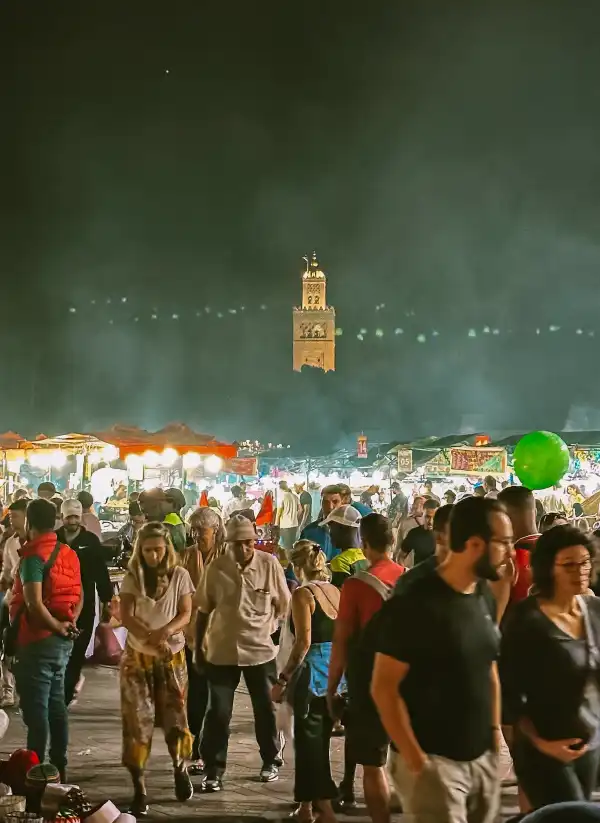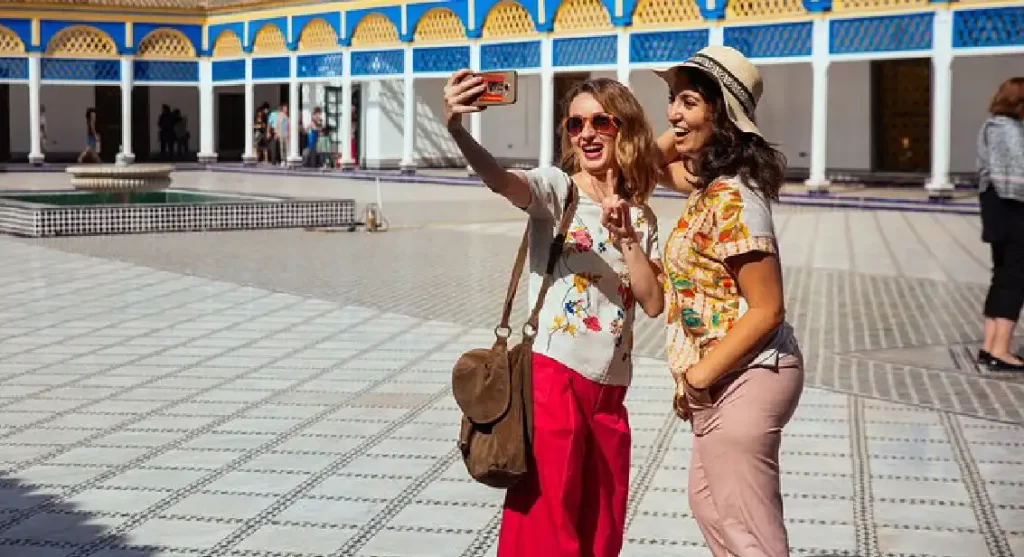
Traveling to Marrakech becomes infinitely more rewarding when you can connect with locals in their own language. While French is widely spoken, knowing some Moroccan Arabic (Darija) will open doors to authentic experiences and genuine friendships. Here’s your practical guide to essential phrases that’ll help you navigate daily life and win hearts in the Red City.
Friendly Greetings
The Basics
| Arabic | English |
| Salam Alaikum | Peace be upon you (formal greeting) |
| Labas? | How are you? |
| Hamdullah | Thank God (the typical response to Labas) |
| Sbah l’kheir | Good morning |
| Msa l’kheir | Good evening |
| B’slama | Goodbye |
| Beslama | See you later |
Making Friends
| Arabic | English |
| Ana smiti… | My name is… |
| Shnu smitk? | What’s your name? |
| M’sherfin | Nice to meet you |
| Sahabti/Sahabi | My friend (female/male) |
| Merhba bik | Welcome |
Daily Communication
Essential Phrases
| Arabic | English |
| Afak | Please |
| Shukran | Thank you |
| Smeh li | Excuse me |
| Wakha | Okay |
| Fahmt | I understand |
| Ma fahmt sh | I don’t understand |
| Shwiya b shwiya | Slowly please |
| 3endi swala | I have a question |
Getting Around
- Fin…? – Where is…?
- L-medina – The old city
- S-suq – The market
- Taxi – Taxi
- Sha7al? – How much?
- Ghali bezzaf – Too expensive
- Qrib/B3id – Near/Far
- Nishaan – Straight ahead
- Duz – Go through
- Dir lima – Turn left
- Dir limn – Turn right
Food & Dining
Restaurant Phrases
- Bghit nakul – I want to eat
- Menu min fadlk – Menu please
- Bghit qhwa – I want coffee
- Atay – Moroccan tea
- Mzien bezzef – Very good
- B’saha – Cheers/Enjoy your meal
- L’ma – Water
- Hot/Bard – Hot/Cold
Common Foods
- Khobz – Bread
- Hrira – Traditional soup
- Tajin – Tagine
- Kefta – Meatballs
- Djaj – Chicken
- Hut – Fish
Cultural Tips
Showing Appreciation
- Zwina/Zwin – Beautiful/Handsome
- Merhba – You’re welcome
- Barak llah ufik – God bless you (used as thank you)
- La bas 3lik – No worries
Building Relationships
- Start Small: Begin with basic greetings and gradually expand your vocabulary
- Show Respect: Using phrases like “Allah y-bark fik” (God bless you) shows cultural awareness
- Accept Invitations: If invited for tea, saying “Inshallah” (God willing) is more polite than a direct yes or no
Pronunciation Tips
- The letter ‘3’ represents a deep throat sound (like clearing your throat)
- ‘Kh’ is pronounced like the ‘ch’ in Scottish ‘loch’
- ‘Gh’ is similar to the French ‘r’
- ‘Q’ is a deeper version of ‘k’
Cultural Context
Remember that Moroccan Arabic is highly contextual. The same phrase might have different meanings depending on the situation. Don’t be afraid to make mistakes – locals generally appreciate any effort to speak their language and will often help you learn.
Digital Resources
While learning these phrases is essential, consider downloading these useful apps:
- Google Translate (with Arabic downloaded for offline use)
- Arabic Dictionary
- Language learning apps with Moroccan Arabic options
Final Tips
- Practice with shopkeepers and taxi drivers – they’re used to foreign speakers
- Learn numbers early – they’re crucial for shopping and transportation
- Record locals speaking phrases you want to learn
- Don’t be shy about making mistakes – they often lead to memorable conversations
Remember, language is the key to culture. Even basic phrases can transform your experience from tourist to welcomed guest. The warmth and hospitality of Marrakchis will make your learning journey worthwhile.
I’ve created a comprehensive guide to essential Moroccan Arabic phrases and cultural tips for connecting with locals in Marrakech. Would you like me to add any specific scenarios or expand on certain phrases? Or would you like some practice dialogues using these phrases?